How Do You Keep Your Family Safe in Summer Heat and Sun?
Heat and sun safety comes down to hydration, shade, sunscreen, and a few easy products. Here is how to keep your family cool and protected all summer long.
By the second week of summer break, somebody is always too hot, too sunburned, or melting down in the driveway. Heat and sun safety really comes down to a few simple habits. Stay hydrated, get into shade during the hottest part of the day, reapply sunscreen, and keep a couple of cooling tools nearby.
You do not need anything complicated or expensive to keep your family safe in the heat. In this post you will find the easy, realistic ways we keep everyone cool, protected, and out of the urgent care waiting room all summer.
Key Takeaways
- Hydration and shade matter most. Water breaks every 15 to 20 minutes and a break from direct sun during peak hours prevent most heat trouble.
- Heat sends a lot of families to the ER. There were 119,605 heat-related emergency room visits in the US in 2023, and 92 percent happened between May and September, according to the CDC (2024).
- Sunscreen only works if you reapply it. The American Academy of Dermatology found 65 percent of people often forget.
- Kids heat up faster than adults, so they need closer watching on hot days.
- A handful of cheap products (electrolytes, a fan, sunscreen, a hat, aloe) cover almost everything.
Disclaimer: This post contains affiliate links. For more information, see my disclosures here. As an Amazon associate, we earn from qualifying purchases.
What Is the Most Important Part of Heat and Sun Safety?
The most important part of heat and sun safety is staying ahead of it with water and shade before anyone overheats. Hydration and a cool-down spot do more than any single product.
On hot days, kids rarely stop to drink on their own. Offering water every 15 to 20 minutes keeps dehydration from sneaking up while they play.
Shade matters just as much. The sun is strongest between 10 a.m. and 2 p.m., so that is the window to head for a tree, an umbrella, or inside for a bit.
This is also where a little planning saves the whole afternoon. Filling water bottles the night before and keeping a fan and sunscreen by the door means one less thing to scramble for when everyone wants to go outside.
How Hot Is Too Hot for Kids to Play Outside?
It is too hot for kids to play outside when temperatures and humidity climb high enough that they cannot cool down, usually in the early afternoon on the hottest summer days. That is when heat illness becomes a real risk.
Heat is not a small thing. Heat-related ER visits in 2023 ran about 20 percent higher than the previous five-year average, according to the CDC (2024), and the agency lists children among those most sensitive to heat.
Watch for flushed cheeks, crankiness, headaches, dizziness, or a kid who suddenly stops sweating. Those are signs to get inside, cool down, and drink fluids right away.
On the hottest afternoons, it helps to flip the schedule. Save outdoor play for the morning or the cooler evening hours and keep midday for water tables in the shade, popsicles, or quiet time indoors.
How Often Should You Reapply Sunscreen in Summer?
You should reapply sunscreen every two hours in summer, and sooner after swimming or sweating. That is the part most of us forget.
The numbers back that up. The American Academy of Dermatology found that only about a third of Americans reapply every two hours, and just 20 percent use sunscreen on cloudy days, even though up to 80 percent of UV rays still get through the clouds.
Use a broad-spectrum, water-resistant sunscreen with SPF 30 or higher. SPF 30 blocks about 97 percent of UVB rays, so it is plenty for most family days.
Childhood sun matters for the long haul too. The AAD notes that severe sunburns in childhood greatly raise the risk of melanoma later in life, and one in five Americans will develop skin cancer at some point. Protecting little ones now is genuinely worth the two-minute reapply.
Why Are Kids More at Risk in the Heat Than Adults?
Kids are more at risk in the heat than adults because their bodies heat up faster and they do not always recognize when they need a break. That combination is what makes summer heat sneaky with little ones.
This shows up most dangerously in parked cars. A child’s body temperature rises three to five times faster than an adult’s, and about 37 children die each year from vehicular heatstroke, which works out to roughly two children a week during summer, according to the NHTSA. Rolling windows down or parking in the shade does very little to change the inside temperature.
The simplest habit here is to always check the back seat before you walk away from the car. Leaving a bag, phone, or shoe in the back is a low-tech way to make sure you open that door every single time.
What Heat and Sun Safety Products Actually Help?
The heat and sun safety products that actually help are the ones that keep your family hydrated, shaded, and protected without much effort. These are the ones we reach for all summer.
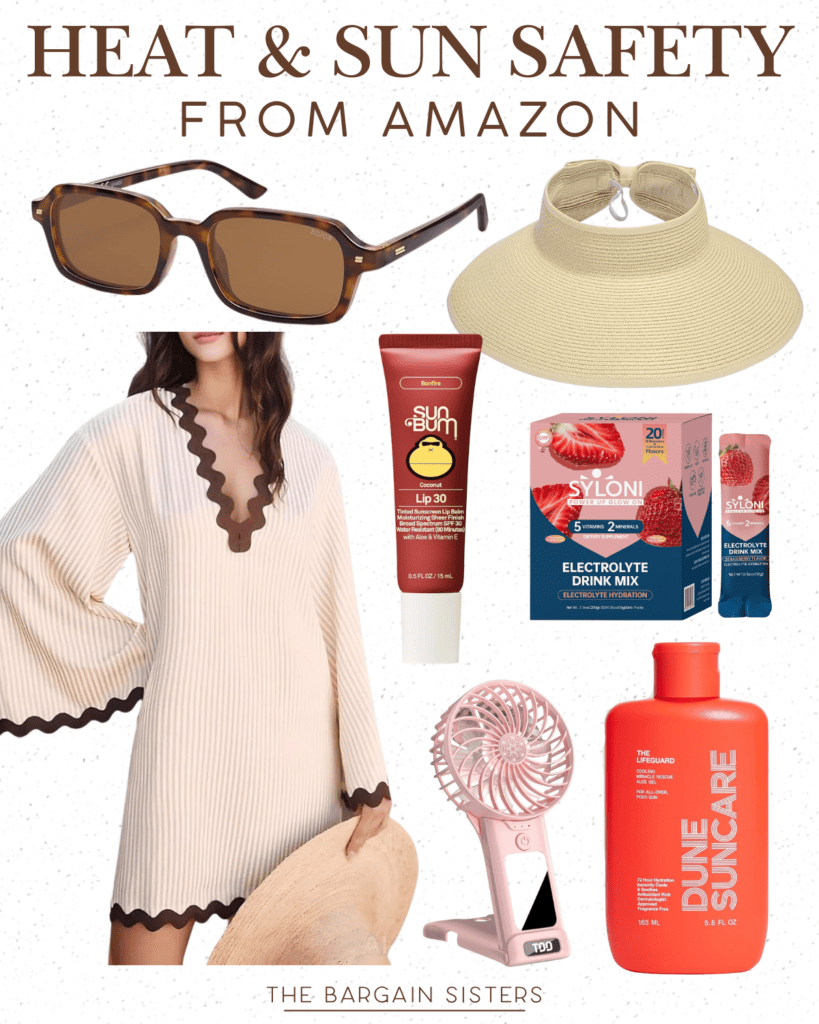
Here are seven simple finds that cover the basics.
- Electrolytes Powder Packets, Strawberry. Plain water is great, but on really hot, sweaty days these help kids rehydrate faster and ward off that wiped-out, headachy feeling. The single packets are easy to toss in a bag for the pool or the ballpark.
- Mini Handheld Fan. This is the thing that buys you ten more minutes in a hot line at the splash pad or the fair. It clips to a stroller and gives a quick cool-down when there is no shade in sight.
- The Lifeguard Aloe Vera Sunburn Gel. For the sunburn that slips past you anyway, this takes the sting out fast. Keep it in the fridge so it feels extra cooling on pink shoulders after a long day outside.
- Women’s Boho Striped V-Neck Dress Flowy Bell Sleeves Cover Up. Lightweight, breezy coverage keeps the sun off your skin without making you hotter. It throws right over a swimsuit for pool pickup or a quick grocery run.
- Sun Hats for Women Fashionable Womens Wide Brim Hat. A wide brim shades your face, ears, and neck, which are the spots most likely to burn. It is the easiest sun protection there is because you just put it on and forget about it.
- Sun Bum SPF 30 Sunscreen Bonfire Tinted Lip Balm. Lips burn too, and most of us never think to protect them. This adds a little tint and SPF in one swipe, so it actually gets used.
- Trendy Rectangle Polarized Sunglasses Womens. Polarized lenses cut the glare on bright pool and beach days and protect your eyes from UV. They make squinting through carpool pickup a lot more bearable too.
FAQs
Watch for heavy sweating, flushed skin, headache, dizziness, nausea, and unusual crankiness. Move them to a cool spot, give fluids, and call your doctor if they do not improve quickly or stop sweating.
About every 15 to 20 minutes, even if they say they are not thirsty. Kids often do not notice they are dehydrated until they already feel bad.
Yes. Water-resistant sunscreen still wears off, so reapply every two hours and right after swimming or sweating.
No. A child’s body heats up three to five times faster than an adult’s, and cars get dangerously hot fast, so never leave a child alone in a vehicle even briefly.
A broad-spectrum, water-resistant sunscreen with SPF 30 or higher is recommended for most families, since SPF 30 blocks about 97 percent of UVB rays.
Heat and sun safety is really just a handful of small habits stacked together. Fill the water bottles, find some shade, reapply the sunscreen, and keep a few cooling tools by the door.
None of it has to be perfect. Getting most of it right, most of the time, is what keeps everyone happy and out of the heat. Want to keep this handy for the next heat wave? Pin the image below so it is ready when you need it.
More Heat and Sun Safety Tips
If you enjoyed these ideas, make sure to pin the image below to reference later!


By Cassie & Ali – Bargain-hunting sisters and moms helping 500,000+ families save money since 2019.
Last Updated: